

The Impact of Stuff
(When it Starts to Feel Heavy)
Stuff doesn’t feel like a problem at first. We’re human. We buy things, we keep things, we hold onto things for later. And honestly, a lot of it feels justified in the moment — A sale. A “just in case.” Something we might use eventually.
The problem isn’t one thing.
It’s the accumulation of many things.
And today, it’s easier than ever to bring more into our homes than we realistically have the time or capacity to use.
Buying vs. Keeping:
Buying something is quick. It feels good in the moment.
Keeping it is the long-term commitment. So it takes up space. It needs to be stored, moved, cleaned around, and eventually dealt with.
That part doesn’t feel as good.
The Build Up:
It builds slowly.
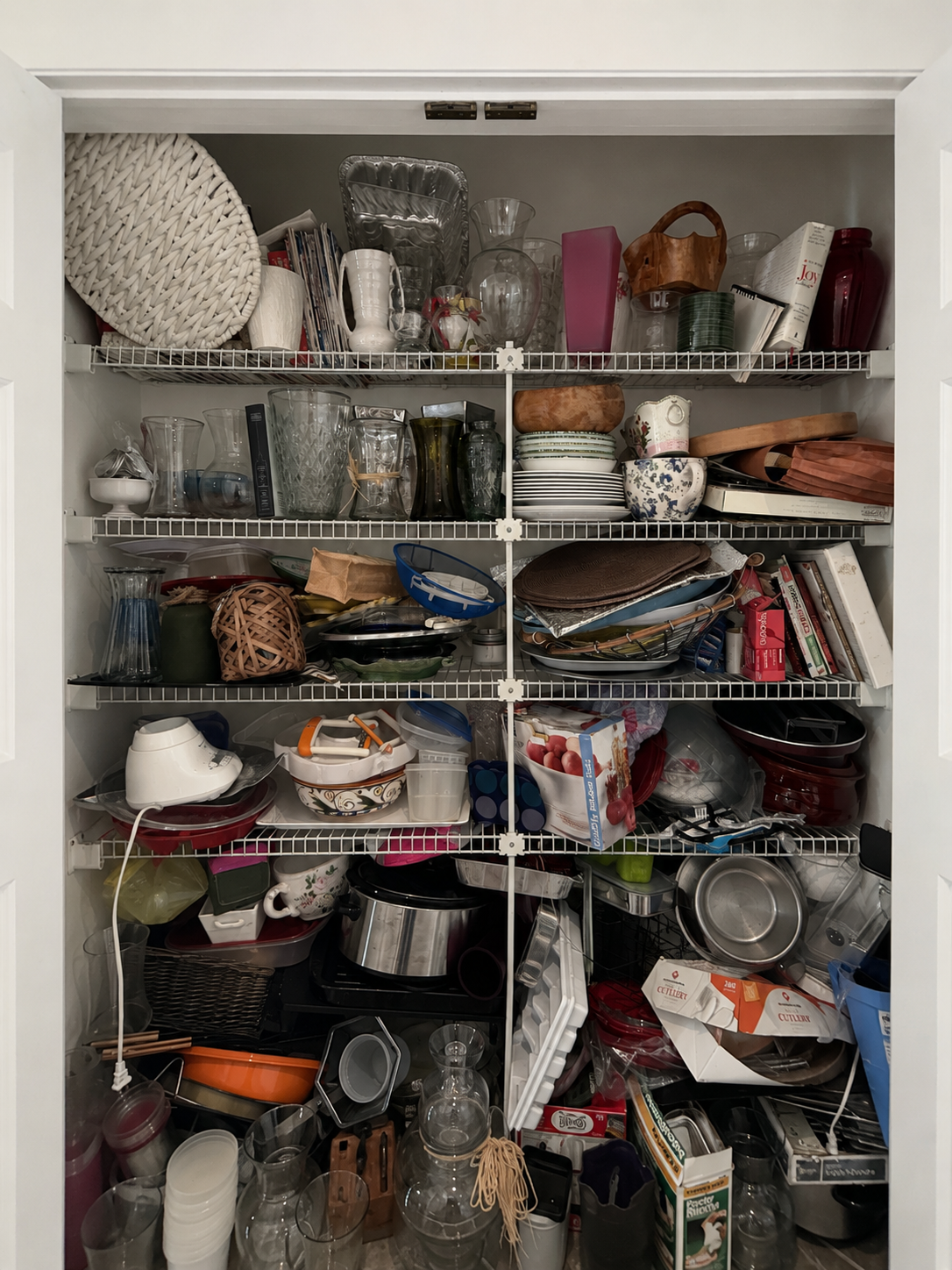
And over time, it starts showing up everywhere:
The closets that become catch-all spaces for things you're not sure what to do with.
The clothes you don’t wear, but still flip past every morning, and still can’t part with.
The surfaces that never stay clear because things just keep landing there.
The drawers that barely open anymore because they’re so full.
The stack of mail or papers you’ve been meaning to go through for months.
The boxes from your last move that you avoid because you don’t even know where to start.
Some of these things can already feel overwhelming on their own.
So when multiple areas of your home start carrying that same weight at the same time, it becomes a lot for anyone to hold mentally.
The Impact:
It’s not just about how it looks.
It’s the constant, low-level mental weight of it all:
visual noise every time you walk into a room
more time spent cleaning, moving, and managing things
not being able to find what you need
putting things off because dealing with it feels overwhelming
And eventually, it starts affecting how you live.
You avoid certain spaces. You don’t want people over. It sits in the back of your mind more than you’d like to admit.
The real cost isn’t the stuff. It’s the time and energy it takes to manage it.
Where Relief Starts
Most homes aren’t struggling because of one thing. It’s the “just in case” mindset showing up everywhere:
you might need it someday (but you never use it)
it still works, so you keep it (but you never use it)
you spent money on it (but you never use it)
you’ll deal with it later (but you never use it)
it could be useful for something (but you still never use it)
Do we see the pattern yet?
We repeatedly hold on to things for logical reasons, despite never using them. The justifications usually feel logical. But they don't always reflect our current routines, priorities, or needs.
Over time, those habits slowly turn into physical and mental clutter that becomes harder to ignore.
And while reducing the volume isn’t always simple, it’s often where relief starts. When you start focusing more on what you actually use and need, things begin to feel easier.
Easier to maintain.
Easier to move through.
Easier to live in.
Not perfect,
Just easier.